The next evolution of enterprise security architecture in the age of autonomous software engineering
By Ayo Dada | Enterprise Security Architecture, Identity Security & Continuous Assurance
The emerging challenge
Artificial intelligence is fundamentally changing how enterprise software is engineered.
AI-assisted development tools can now generate substantial amounts of code, refactor applications, analyse repositories, execute tests and interact with deployment environments.
Increasingly, autonomous coding agents can undertake activities that previously required human developers working through established engineering processes.
But this transformation raises a fundamental question:
If organisations can produce and change software faster than they can understand, govern and assure it, are we creating a new generation of security and architectural risk?
I recently followed a Secure by Design discussion that raised two important concerns.
Steve’s discussion of memory safety highlighted why addressing fundamental classes of software vulnerabilities remains essential.
Robert raised a different, but equally significant concern: AI-generated code can introduce unnecessary complexity, creating systems that become progressively more difficult for engineers to understand, maintain and modify.
Both perspectives point towards a wider enterprise architecture challenge.
The problem is no longer just whether individual pieces of software are secure. It is whether organisations can maintain control over the architectural integrity and security of increasingly autonomous software engineering.
Secure by Design remains essential — but is it sufficient?
Traditional Secure by Design principles are not obsolete.
Threat modelling, secure coding, memory-safe programming languages, architecture reviews, segregation of duties, security testing and software supply-chain controls remain fundamental.
CISA and the NSA have reinforced the importance of memory-safe languages in eliminating entire classes of vulnerabilities rather than repeatedly addressing individual defects.
However, memory safety addresses only part of the problem.
A memory-safe application can still have excessive privileges, insecure authorisation logic, poorly designed APIs, undocumented dependencies or fundamentally unsuitable architecture.
Similarly, AI-generated code can compile successfully and pass functional tests while failing to meet an organisation’s security control requirements.
The distinction between functional correctness, security correctness and architectural fitness is becoming increasingly important.
Secure by Design must therefore govern not only how software is developed, but also how design decisions, security requirements and engineering outcomes remain aligned throughout continuous change.
The hidden risk: architectural complexity and assurance debt
One of my concerns is the potential accumulation of what I would describe as assurance debt.
Technical debt arises when engineering shortcuts create future maintenance costs.
Assurance debt develops when the pace of system change exceeds an organisation’s ability to demonstrate that its architecture, security controls, risk decisions and operational safeguards remain valid.
Consider an AI coding agent tasked with improving an enterprise application’s authentication process.
The agent might successfully implement a new authentication library, update API endpoints, modify session handling and generate automated tests.
The application may work as expected.
But several questions remain.
Has the implementation preserved the organisation’s identity architecture principles?
Does it comply with established authentication and authorisation controls?
Have service identities, secrets and privileged access requirements changed?
Has the agent introduced new dependencies, trust relationships or security exceptions?
Can the organisation demonstrate which requirements were satisfied, what was tested, and who authorised the change?
A successful pull request does not automatically answer these questions.
Passing a build is not the same as satisfying an architectural control.
This is where traditional assurance processes risk becoming disconnected from modern engineering delivery.
From document-based governance to machine-readable security architecture
My perspective is that enterprise security architecture must evolve towards a more explicit, traceable and machine-readable control model.
Many organisations still express their architectural requirements across policies, standards, Word documents, reference architectures, design specifications, spreadsheets and review-board decisions.
These artefacts remain valuable.
But when AI-driven engineering systems operate continuously, security requirements cannot depend entirely on humans manually interpreting disconnected documentation after implementation.
Instead, security architecture should increasingly be expressed through structured control requirements, enforceable design constraints, versioned architecture decisions and verifiable evidence.
I see six interconnected capabilities becoming particularly important:
- Machine-readable security requirements: Stable control identifiers and structured requirements that can be mapped to applications, technology components and engineering workflows.
- Architecture decision traceability: Explicit relationships between business requirements, threat models, security controls, design decisions and implementation artefacts.
- Identity and authority governance for engineering agents: Defined ownership, least privilege, approved tool access, credential controls and clear boundaries on autonomous actions.
- Policy and control enforcement: Automated architectural and technical checks within CI/CD pipelines, infrastructure-as-code processes and agent execution environments.
- Evidence-based security assurance: Traceable test results, software provenance, configuration evidence and documented treatment of unresolved findings.
- Continuous reassessment: Revalidation when code, dependencies, identities, configurations or trust relationships change.
This does not mean replacing security architects with AI.
Nor does it mean expecting another AI system to provide unquestioned assurance over AI-generated software.
It means converting architectural intent into requirements that engineering systems can evaluate, while retaining independent verification and appropriate human decision authority.
A proposed architectural approach
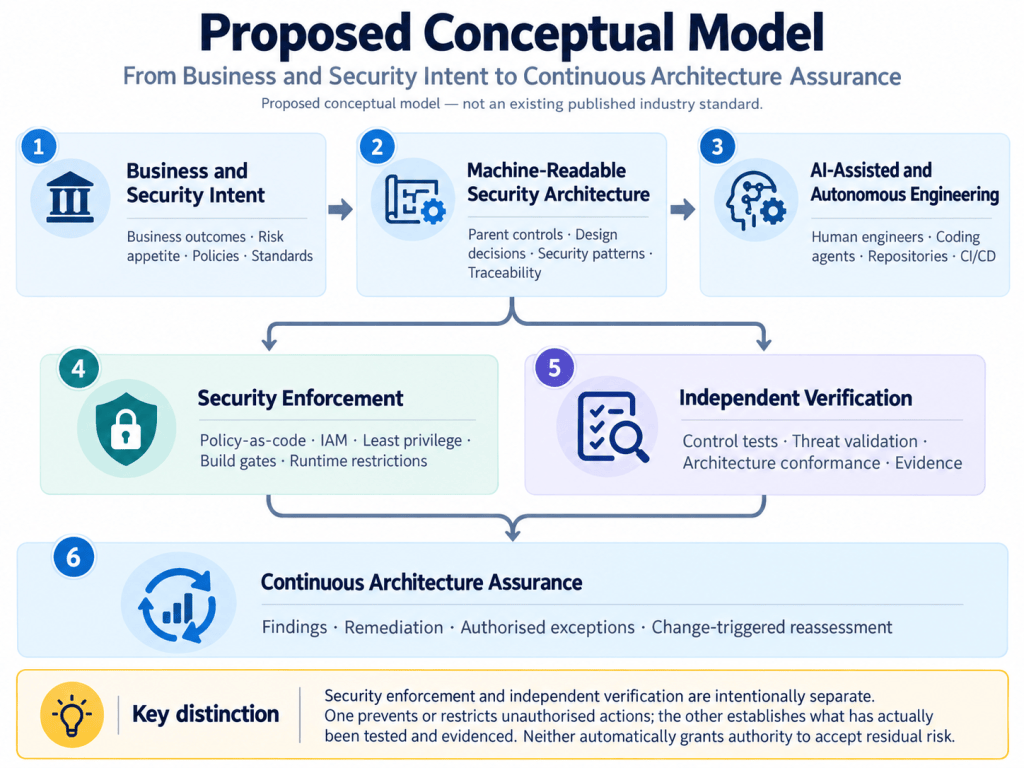
I believe the next evolution of Secure by Design requires an integrated assurance model that connects business and security intent to engineering implementation, automated verification and continuous evidence.
The following conceptual model illustrates how machine-readable security architecture could provide that connection while preserving independent assurance and human accountability for risk decisions.

Identity becomes part of the software engineering control plane
There is another dimension that deserves greater attention: identity and access security.
An autonomous coding agent is not simply a developer productivity tool when it can interact with repositories, APIs, secrets stores, cloud platforms or deployment pipelines.
It becomes an operational actor with delegated authority.
That authority must be governed.
Organisations need to understand which agent is acting, who owns it, what permissions it has, which resources it can modify and whether its actions are appropriately restricted and recorded.
In this environment, established principles such as least privilege, separation of duties, privileged access management and identity lifecycle governance remain relevant.
However, they must be extended to increasingly dynamic non-human and AI-agent activity.
An agent’s ability to generate code should not automatically confer authority to approve, deploy or independently certify that code.
The ability to execute an engineering action is not the authority to accept its associated security risk.
That distinction must remain a fundamental architectural boundary.
The future: Secure by Design, verified by evidence
NIST’s Secure Software Development Framework provides an established foundation for integrating security into software engineering.
OWASP’s emerging agent security guidance further recognises the importance of inspectability, traceability and enforceable controls over autonomous systems.
The opportunity for enterprise architecture is to bring these disciplines together into an integrated assurance model.
In my view, the evolution is towards:
Security intent → Architecture requirements → Engineering implementation → Automated verification → Evidence → Continuous assurance.
The architecture must define what good looks like.
Engineering systems must implement within those boundaries.
Assurance mechanisms must establish what has actually been verified.
And accountable humans must retain authority over formal risk acceptance, material exceptions and critical deployment decisions.
This is not a call to slow down AI innovation.
It is a call to modernise the mechanisms that make innovation trustworthy.
Final thought
The software engineering industry is investing heavily in accelerating code generation.
Enterprise security architecture must invest just as seriously in accelerating the verification of security intent.
The organisations that succeed will not necessarily be those generating the most code.
They will be those capable of demonstrating that continuously changing systems remain secure, governable, maintainable and aligned with business risk.
AI is changing how software is built. Enterprise security architecture must now change how trust is established and maintained.
My question to fellow security architects, engineering leaders and CISOs:
Are our Secure by Design practices genuinely evolving for autonomous software engineering, or are we applying yesterday’s assurance processes to tomorrow’s development speed?


Leave a Reply